
Punt Road Oval — Richmond’s Heritage Tigers’ Den
Punt Road Oval was Richmond’s home until 1965, and it’s still where the Tigers train every week. A heritage suburban ground at the corner of Punt Road and Brunton Avenue, directly opposite the MCG, Punt Road hosted the Richmond Football Club from the club’s foundation in 1885 until 1965. The Tigers won six VFL premierships during the Punt Road era (1920, 1921, 1932, 1934, 1943, 1967), though the 1967 flag was technically built on Punt Road home form even after the club had moved fixtures elsewhere. The ground survives as Richmond’s training base and is one of the most active retained-heritage suburban grounds in Melbourne.
The History: 1885 and Richmond’s Foundation
Punt Road Oval has been a sporting venue since the 1860s, with cricket from the 1870s and football from the 1880s. Richmond Football Club, founded in 1885, made Punt Road its home from inception. The club joined the VFL in 1908 (later than the foundational clubs), making Punt Road its VFL home from 1908 to 1965.
The venue progressively expanded:
- 1900s–1920s: Wooden grandstands built.
- 1930s–1950s: Capacity expansion and modernisation.
- 1960s: Limited modernisation as Richmond planned the move to the MCG.
- 1965 onwards: Reverted to community football, Tigers training base.
Capacity at peak: ~32,000.
The Footy: Richmond’s Premiership Foundation
Richmond played at Punt Road Oval from 1908 to 1965 — 57 years of unbroken VFL home-ground occupation. The Tigers won six premierships during this era:
- 1920 — Tigers’ first VFL flag
- 1921 — back-to-back
- 1932 — building dynasty
- 1934 — sustaining success
- 1943 — wartime flag
- 1967 — first MCG-era flag (training and home form built at Punt Road)
The pitch was ~155m × 130m. The wind off the Yarra River was a known factor in afternoon games.
The Move to the MCG
By 1965, the AFL was strongly encouraging Richmond to relocate to the MCG. The corporate facilities at Punt Road were dated; the broadcast infrastructure was poor; and the AFL preferred MCG fixtures for league-wide commercial reasons. Richmond complied; the final VFL fixture at Punt Road was in 1965.
Famous Moments
- 1908 inaugural Richmond VFL fixture at Punt Road.
- 1920, 1921 back-to-back premierships.
- 1932, 1934 premierships.
- 1943 wartime premiership.
- Jack Dyer’s career at Richmond was largely played at Punt Road.
- 1965 farewell fixture.
- 2017 Tigers premiership celebration — Richmond’s MCG triumph was celebrated at Punt Road.
The Stadium Itself (Then and Now)
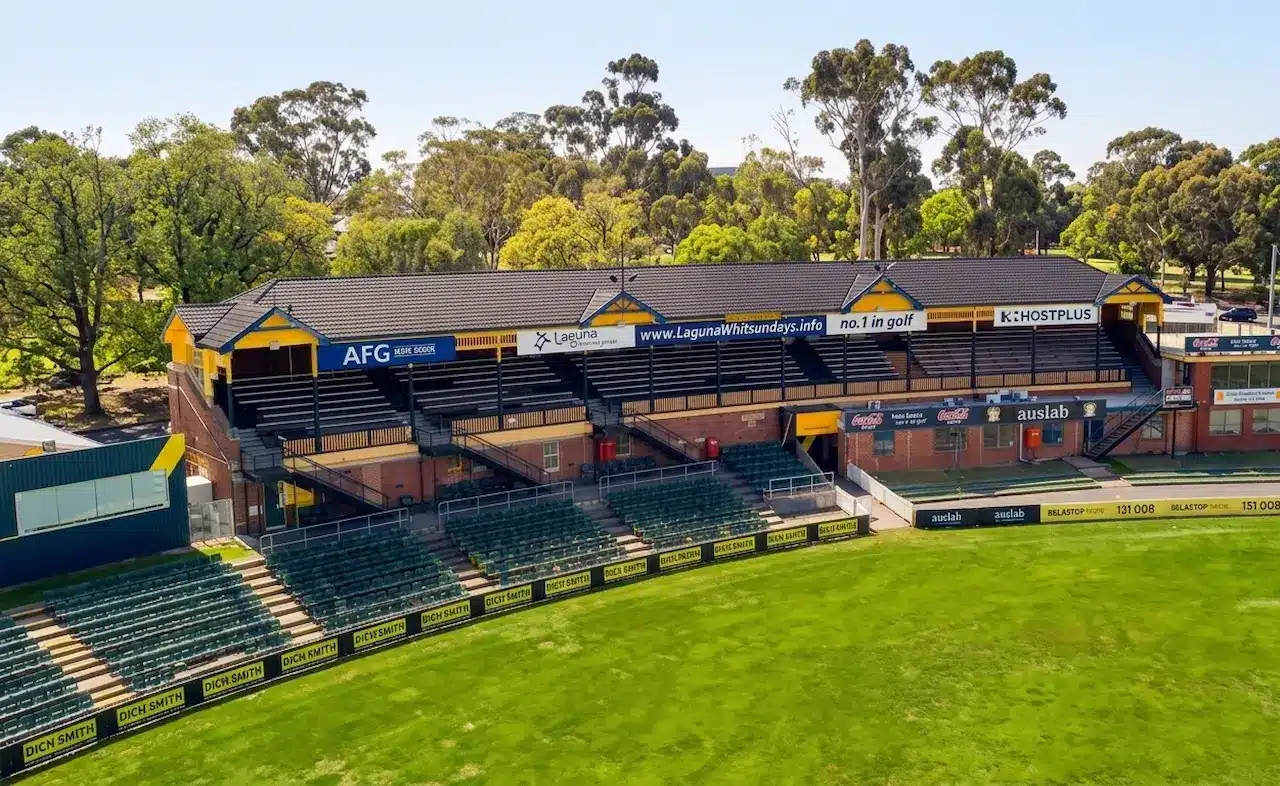
Punt Road Oval, in its heyday, had wooden grandstands, an open grass embankment, and modest corporate facilities. The venue had genuine character directly opposite the MCG, in working-class Richmond, surrounded by terrace houses and the kind of inner-Melbourne pubs where the publican knew every player’s nickname.
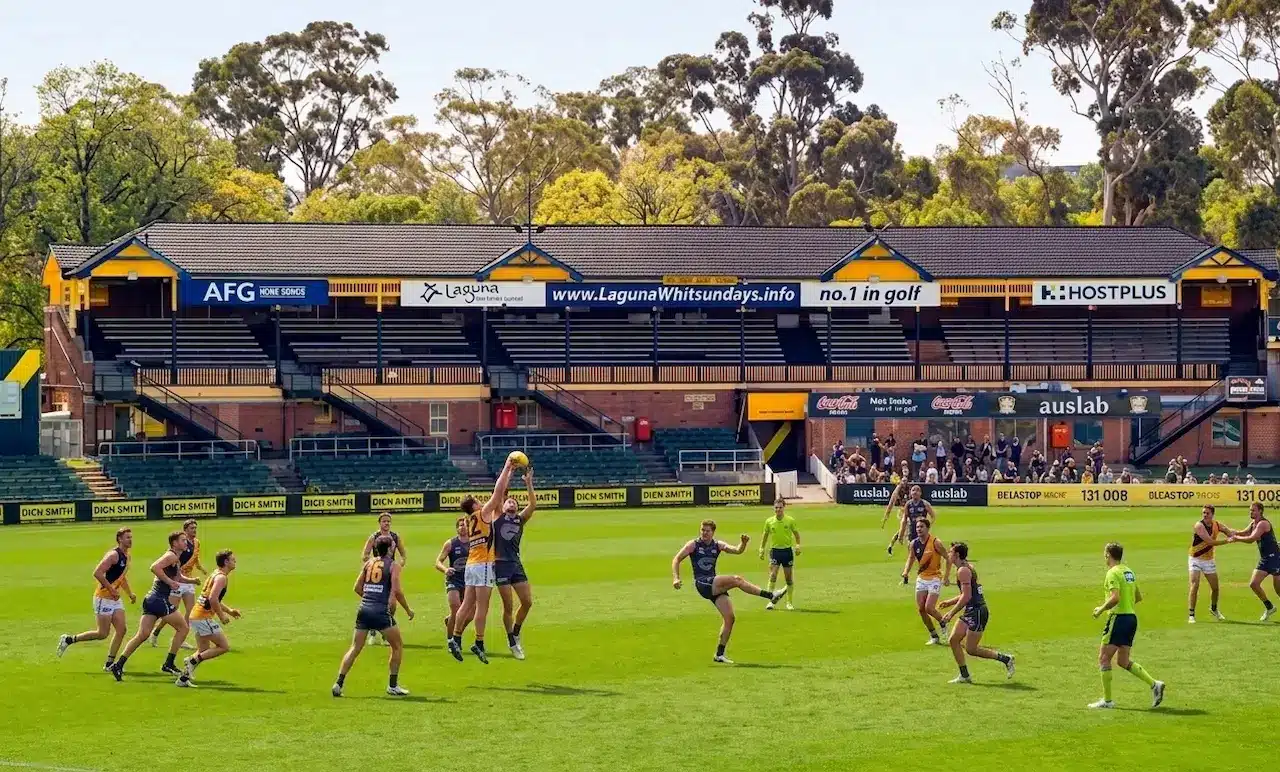
Today, the ground is Richmond’s training base and a community sporting venue. The pitch is preserved; some heritage features remain; and the Tigers’ VFL/AFLW teams play home games here.
Trivia for the Pub
- Richmond played at Punt Road Oval for 57 unbroken VFL years (1908–1965).
- The Tigers won six VFL premierships during the Punt Road era.
- The ground is directly opposite the MCG across Brunton Avenue.
- Punt Road Oval is now Richmond’s training base and VFL/AFLW home ground.
- Jack Dyer’s iconic career was largely played at Punt Road.
- The ground is part of the Yarra Park sporting precinct.
- Tigers’ 2017, 2019, and 2020 premierships were preceded by training at Punt Road.
The Rumours
The persistent rumour: VFL/AFLW finals at Punt Road. Has been canvassed periodically; some VFL preliminary finals have been hosted here.
The other rumour: major redevelopment. Has been mooted; funding has not landed.
The Verdict
Punt Road Oval is one of the most successful retained-heritage suburban grounds in Melbourne. The Tigers’ premiership history was built here; the modern Richmond squad still trains here; and the ground continues to play a meaningful role in inner-Melbourne footy culture. Walk past Punt Road on a Saturday, and you’ll see the Tigers training, the pitch maintained, and the heritage character preserved. Long live Punt Road.