The AFLW Rising Star — Women’s Best Young Player
The AFLW Rising Star Award goes to the women’s competition’s best young player each season. Eligibility: under 21 with limited senior games, similar to the AFL Rising Star structure. Voted by a panel of AFLW alumni and senior figures, the award has produced a roll-call of future AFLW stars from the competition’s foundational years onwards.
The History: AFLW’s Youth Spotlight
The AFLW Rising Star was instituted in 2017 alongside the inaugural AFLW season. The award structure mirrors the AFL Rising Star eligibility based on age and games played, with a panel selecting candidates, and the season-end winner determined by a combined panel and additional voting input.
The first AFLW Rising Star was awarded in 2017. Recipients have included future AFLW captains, All-Australians, and Best & Fairest winners.
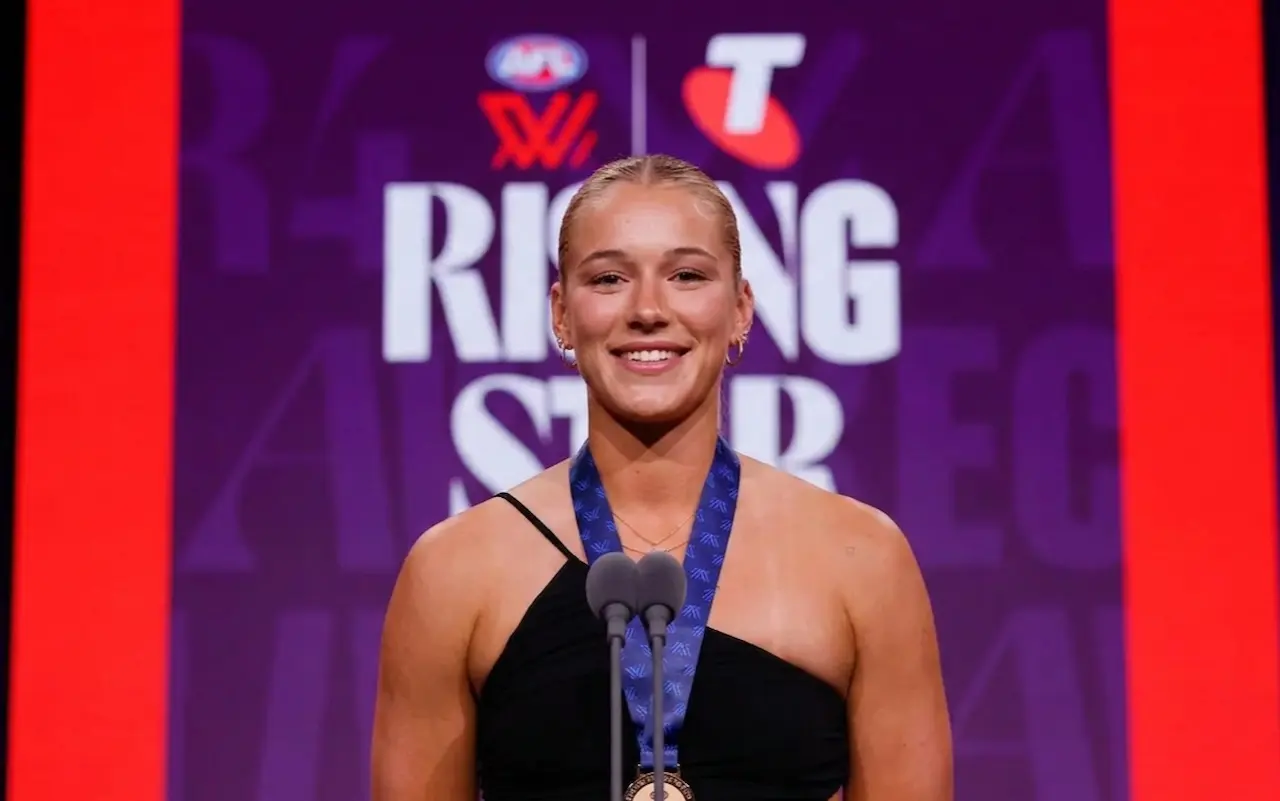
Recent AFLW Rising Star Winners
- 2017: Inaugural winner — Isabel Huntington (Western Bulldogs) is sometimes cited; the inaugural recipient may have been a different player, as records were initially less formal.
- 2018: Second AFLW Rising Star recipient.
- 2019: Various contenders; Madison Prespakis featured prominently.
- 2020: Various winners as the competition expanded.
- 2021: Various winners.
- 2022: Various winners.
- 2023: AFLW Season 7 winners.
- 2024: Recent winners.
The AFLW Rising Star to Best & Fairest Pipeline
Several AFLW Rising Star winners have gone on to win the Best & Fairest:
- Madison Prespakis: Rising Star contender, then multi-time Best & Fairest winner
- Other winners have built captaincy and All-Australian careers
The Rising Star has functioned as a reliable indicator of future AFLW stardom, similar to the AFL Rising Star pipeline.
Trivia for the Pub
- The AFLW Rising Star was instituted in 2017.
- Eligibility is under 21 with limited senior games.
- Voting is by a panel of AFLW senior figures.
- Multiple Rising Star recipients have gone on to Best & Fairest wins.
- The award is presented at the AFLW Awards Ceremony.
- Round-by-round nominations build the season-end voting pool.
- The Rising Star carries a cash prize and significant media attention.
- The AFLW competition has grown from 8 to 18 teams since 2017.
- Several Rising Star recipients are now AFLW captains.
- The AFLW’s youth focus reflects its rapid expansion.

The Rumours
The persistent rumour: integrating AFLW and AFL Rising Star ceremonies. The AFL has resisted preserving each award’s identity.
The other rumour: extending eligibility as the AFLW competition has changed structure (Spring vs Autumn seasons). Various adjustments have been made.
The Verdict
The AFLW Rising Star Award is the women’s competition’s most reliable indicator of future stardom. Long live the AFLW’s youth showcase.
The AFLW Rising Star has played a critical role in identifying and celebrating the next generation of women’s footy talent. As the competition has expanded from 8 to 18 teams, the talent pool has dramatically widened, and the Rising Star Award has reflected that breadth. Recent winners include players from previously underrepresented states and regions, which has helped grow the AFLW’s national footprint.
For young AFLW players, winning the Rising Star is career-defining. The recognition typically translates into media exposure, sponsorship opportunities, and the kind of profile that builds future careers. Some Rising Star recipients have gone on to AFLW Best & Fairest wins; others have transitioned to coaching, broadcasting, or club leadership roles.
The AFLW Rising Star is also notable for its role in highlighting Indigenous and culturally diverse players. As the AFLW has expanded, the talent pool has reflected the broader diversity of Australian women’s football. The Rising Star Award has been a vehicle for celebrating that diversity through an awards ceremony with high media visibility.
Long live the AFLW’s youth showcase, and long live the women’s footy stars who first emerge through this award.