Lake Oval (South Melbourne Cricket Ground) — South Melbourne’s Lost Home
Lake Oval is South Melbourne’s lost home, and it’s now a quiet park most Melburnians walk past without realising what happened there. A heritage suburban ground in Albert Park, hosting South Melbourne Football Club from the late 1800s until the club’s relocation to Sydney in 1982, Lake Oval is footy’s most poignant ghost. The grandstands are gone; the grass survives; the memory of South Melbourne’s eventual emigration to NSW is one of the most consequential decisions in VFL history.
The History: South Melbourne’s 100-Year Home
Lake Oval has been a sporting venue since the 1860s. Located in Albert Park (South Melbourne), the ground was used for cricket initially and then football from the 1880s. South Melbourne Football Club, founded in 1874, made Lake Oval its home in the late 1880s and remained there continuously for nearly a century.
The venue progressively expanded:
- 1900s: Wooden grandstands built.
- 1920s: Capacity expansion.
- 1950s: Modernisation, including covered seating.
- 1980s: Limited modernisation as South Melbourne struggled financially.
Capacity at peak: ~30,000.
The Footy: South Melbourne’s VFL Era
South Melbourne played at Lake Oval from the club’s foundation through to 1981, over 90 years of unbroken home-ground occupation. The club won three VFL premierships (1909, 1918, 1933) during the Lake Oval era. The 1933 premiership remains South Melbourne’s last under that name.
The pitch was ~155m × 132m. Surface: rye-dominant. The location in Albert Park, surrounded by parkland, gave the venue a quieter atmosphere than the working-class suburban grounds of Carlton, Collingwood, and Richmond.
The Sydney Relocation
By the late 1970s, South Melbourne was financially distressed. The club’s working-class supporter base had largely moved to outer suburbs; Lake Oval’s location was no longer central, and the corporate hospitality offerings were dated. The VFL Commission engineered a relocation to Sydney for the 1982 season South Melbourne became the Sydney Swans.
The relocation was deeply controversial. South Melbourne supporters mounted a “Keep South at South” campaign that nearly succeeded. The financial reality won out; the move proceeded. Lake Oval hosted its final VFL fixture in 1981. The ground reverted to community football and cricket use.
Famous Moments
- 1909, 1918, 1933 South Melbourne premierships — built largely on Lake Oval home form.
- Roy Cazaly’s high-flying era at South Melbourne in the 1920s — the original “Up There Cazaly” mark legend was substantially built at Lake Oval.
- Bob Skilton’s 1959, 1963, 1968 Brownlow Medals — won as a South Melbourne player, with Lake Oval as his home ground.
- 1981 farewell fixture — South Melbourne’s final VFL home game at Lake Oval.
- The 1933 Grand Final qualifier at Lake Oval, en route to the club’s last premiership under the South Melbourne name.
The Stadium Itself (Then and Now)
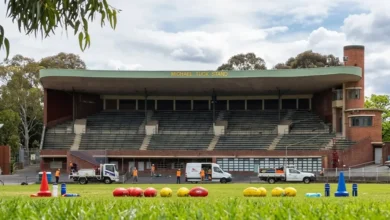
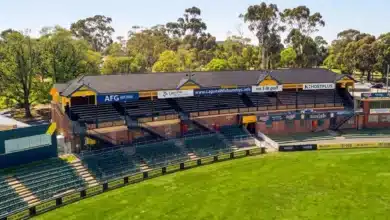
Lake Oval, in its heyday, had wooden grandstands on the western side, an open grass embankment on the east, and a small members’ pavilion. The venue was modest by modern AFL standards but adequate for VFL of its era.
Today, the ground is preserved as a community park within Albert Park reserve. The pitch is still a sporting field used for community cricket and amateur football. Heritage markers commemorate South Melbourne’s history at the site. The venue is part of the broader Albert Park precinct adjacent to the Albert Park Lake (which gives the oval its name) and the Australian Grand Prix circuit.
Trivia for the Pub
- South Melbourne played at Lake Oval for over 90 unbroken years (1880s–1981).
- The club won three VFL premierships during the Lake Oval era (1909, 1918, 1933).
- Roy Cazaly’s high-flying era was at Lake Oval; the song “Up There Cazaly” celebrates these marks.
- The relocation to Sydney in 1982 was the most consequential VFL decision of the 20th century.
- Lake Oval is named after Albert Park Lake, adjacent to the venue.
- Bob Skilton won three Brownlow Medals as a South Melbourne player at Lake Oval.
- The Sydney Swans’ Bob Skilton Best & Fairest is named after the same player.
The Rumours
The persistent rumour: Lake Oval as a future AFL venue. Won’t happen, the ground is now community recreation.
The other rumour: a major heritage memorial. Has been canvassed; modest markers exist.
The Verdict
Lake Oval is footy’s most poignant ghost. South Melbourne’s relocation to Sydney was the most consequential VFL decision of the 20th century. It laid the groundwork for AFL national expansion, it gave Sydney its football identity, and it ended a 90-year tradition of inner-Melbourne suburban football at a single ground. Walk past Lake Oval today, and you’d never know what happened there. But the Sydney Swans exist because of this ground. The footy world we know exists because of this ground. Pour a stubby for South Melbourne.